Voltage & Vision: How Las Vegas Neon Artists Are Rewiring the City's Luminous Soul
Voltage & Vision: How Las Vegas Neon Artists Are Rewiring the City's Luminous Soul
Las Vegas doesn't just use light. It weaponizes it. For decades, the Strip has deployed neon and LED in the same way a casino deploys a free drink — to dazzle, to distract, to keep you moving in the right direction. But somewhere beneath the billion-dollar hotel facades and the choreographed fountain shows, a different kind of glow has been quietly building. A rawer, more intentional light. One that belongs to the artists.
A scrappy, fiercely creative underground scene has taken root in Las Vegas, and it's using the city's own luminous language against the grain. Neon fabricators, digital muralists, and mixed-media collectives are pulling from the city's classic tube-and-gas heritage while pushing hard into augmented reality, projection mapping, and generative digital art. The result is something genuinely exciting — and genuinely Vegas, in a way the Strip hasn't been in years.
Bending Tubes, Breaking Rules
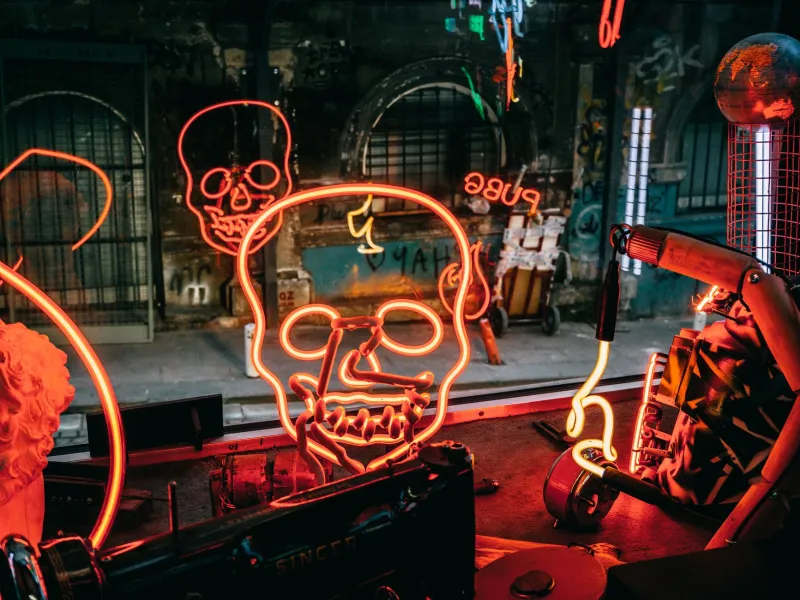
Walk into a studio like Neon Witch Workshop in the Arts District on Charleston Boulevard and you'll immediately sense the tension between old craft and new ambition. Founder and lead fabricator Maya Trevino learned to bend glass tubes the traditional way — slow, patient work with a ribbon burner and decades of muscle memory behind every curve. But her finished pieces look nothing like a vintage motel sign.
"People assume neon is nostalgic by default," Trevino says, gesturing toward a wall-mounted sculpture that pulses with shifting ultraviolet gradients. "But the material itself doesn't care about nostalgia. It just cares about electricity and gas. What you do with that is entirely up to you."
Trevino's recent collaborative series, Frequencies, pairs hand-bent neon tubes with responsive LED underlighting that reacts to ambient sound — so the piece literally changes depending on who's in the room and what they're saying. It's the kind of work that makes you rethink what a neon sign even is.
She's not alone in that rethinking. Across the Arts District and spilling into the neighborhoods surrounding the university, a loose network of creators is treating neon not as a relic but as a raw material for something entirely new.
The Neon Museum as Creative Accelerator
You'd be forgiven for assuming the Neon Museum — that iconic boneyard of retired Las Vegas signage on Las Vegas Boulevard North — is purely a preservation project. A place to mourn the Stardust and the Sands. And sure, that's part of it. But ask the artists who frequent the place after hours, who sketch in its shadow and photograph its rust-streaked giants, and they'll tell you something different.
"The Boneyard isn't a cemetery," says digital muralist and projection artist Darius Okafor, who has used the museum as both a backdrop and a direct inspiration for several large-scale works. "It's a library. Every one of those signs is a design decision someone made with total conviction. I go there to steal ideas — respectfully."
Okafor's work involves projecting animated, neon-palette digital art directly onto architectural surfaces around downtown Las Vegas. His piece Ghost Voltage, which ran for three weekends last fall on the exterior of a repurposed warehouse near Fremont East, layered animated neon typography — fonts pulled directly from mid-century Vegas sign traditions — over shifting cyberpunk cityscapes. The effect was jarring and gorgeous in equal measure: the past flickering inside the future.
The museum itself has leaned into this dynamic, hosting artist residencies and late-night creative events that position the collection not as an endpoint but as a jumping-off point. It's a subtle but meaningful shift — from archive to accelerator.
Collectives Charging the Scene
No single artist is driving this movement. Like any healthy creative ecosystem, it runs on community. The collective known as Phosphor — six artists ranging from traditional sign painters to VR environment designers — has become one of the most visible forces in the scene. Their work deliberately refuses to settle into a single medium.
A recent Phosphor installation at a pop-up gallery space in the Arts District combined hand-fabricated neon tubes, real-time generative visuals coded in Processing, and a physical zine documenting the entire creative process. It sold out in a weekend.
"We're not trying to be the future of neon," says Phosphor co-founder Leila Castaneda. "We're trying to be the conversation between the past and the future. That gap is where the interesting stuff lives."
That conversation is getting louder. Gallery spaces like The Filament and Current Works — both operating in the repurposed commercial spaces that have become the Arts District's signature — are actively programming shows that center neon and digital light as legitimate fine art media. Collectors are showing up. So are curators from out of state.
Neon Meets the Algorithm
Perhaps the most genuinely surprising development in the Las Vegas neon art scene is the crossover with generative and AI-assisted digital art. A small but growing group of creators is using machine learning tools to design neon-inspired digital works that would be physically impossible to fabricate in glass and gas — and then, in some cases, finding ways to fabricate them anyway.
Artist collective Tube Logic has been experimenting with AI-generated neon color palettes, feeding the outputs back into physical fabrication processes to create signs with color transitions and spatial relationships that no human designer would have arrived at intuitively. The results look alien and familiar at the same time — very much neon, but neon from somewhere slightly to the left of reality.
"Las Vegas was always about the impossible made real," says Tube Logic member and programmer-turned-artist Jonah Renfrew. "We're just continuing that tradition with different tools."
Why This Matters Beyond Vegas
It would be easy to treat this scene as a local curiosity — a quirky footnote to the city's showbiz identity. But what's happening in Las Vegas right now has implications that reach well beyond the desert. As digital art continues to blur the lines between screen-based and physical media, the city's unique heritage — a century of treating light as a primary artistic and commercial language — gives its artists a distinct and powerful starting point.
The neon artists of Las Vegas aren't just preserving a legacy. They're stress-testing it, pulling it apart, and rebuilding it into something that can carry the weight of a genuinely contemporary creative conversation. The glow is the same. Everything else is different.
And honestly? That's exactly the kind of voltage this city has always run on.