Charged and Collected: How Neon Sculpture Is Earning Its Place in the American Fine Art Canon
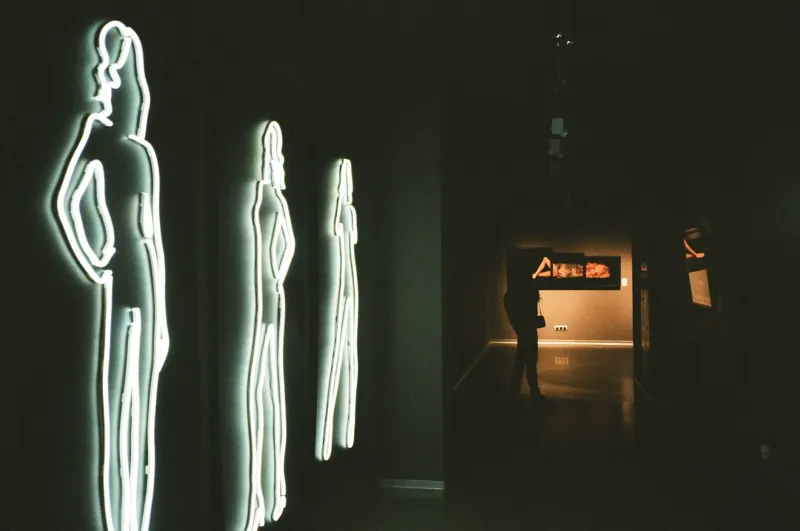
There's a moment that happens in a darkened gallery when a neon sculpture flickers to life. The hum is almost imperceptible. The color bleeds into the air like something alive. And suddenly, whatever assumptions you walked in with — that neon belongs on a diner window or a Vegas marquee — quietly dissolve. That moment is happening more and more across American art spaces, and the people engineering it are a new wave of sculptors who have decided that glass and gas are as legitimate a medium as oil on canvas or silver gelatin print.
Neon sculpture isn't new, exactly. Bruce Nauman was bending the stuff into provocative text pieces back in the late '60s. Keith Sonnier made light a material concern in the early '70s. But what's different now is the sheer volume of serious artistic voices entering the conversation — and the institutional machinery starting to back them up.
From the Street to the Museum Wall
Walk through a contemporary art fair in New York or Los Angeles today and you'll notice neon showing up not as novelty or decoration, but as the main event. Artists like Tavita Faleolo, who works out of a studio in Brooklyn, are creating large-scale neon installations that explore themes of diaspora and identity — looping Samoan phrases in glowing magenta across steel armatures, forcing viewers to reckon with language, visibility, and what it means to be seen in America.
In Chicago, sculptor Mara Lentz has been building what she calls "emotional architecture" — room-sized neon environments where color temperature and tube placement are calibrated to produce specific psychological responses. Her 2023 installation at the Chicago Cultural Center drew lines around the block and a profile in Artforum. That's the kind of crossover moment that signals a medium is being taken seriously.
On the West Coast, Los Angeles-based artist Dae-Jin Park has been quietly amassing a collector following with wall-mounted neon works that fuse Korean calligraphy with abstract geometric forms. His pieces sell in the $40,000–$120,000 range, and he recently placed work with two major museum collections — institutions that, five years ago, might have passed on neon entirely.
The Craft Underneath the Glow
What separates neon sculpture from neon signage isn't just intent — it's also the extraordinary level of technical mastery involved. Glass bending, or "tube work" as it's called in the trade, is a dying craft. There are fewer than a few hundred true neon artisans left in the United States who can execute the kind of complex, multi-radius bends that fine art demands. Many serious neon sculptors spend years learning the craft themselves, or work in deep collaboration with the remaining master benders.
New York-based artist Simone Arquette trained in traditional glass-blowing before pivoting to neon, and she'll tell you the two disciplines aren't that different in spirit — both require patience, physical precision, and a willingness to let the material surprise you. "Glass has memory," she says. "It wants to move in certain ways. You negotiate with it." Her recent series, Soft Infrastructure, features suspended neon tubes arranged to mimic urban utility lines — power cables, water pipes, communication networks — rendered in spectral purples and greens that transform industrial anxiety into something almost tender.
Curators Are Paying Attention
The institutional response to neon sculpture has shifted noticeably in the last half-decade. Museums that once categorized neon as decorative or commercial are now actively acquiring and commissioning work. The reasons are layered.
Partly, it's generational. A new cohort of curators who grew up surrounded by digital light — screens, LEDs, glowing interfaces — have a different relationship to luminous media than their predecessors did. Neon doesn't read as lowbrow to them; it reads as foundational, a precursor to the visual language they've always known.
Partly, it's market pressure. Collectors in their 30s and 40s are drawn to neon sculpture in ways that are reshaping gallery programming. These buyers want work that photographs well, yes, but more than that, they want work that feels like right now — that hums with the same frequency as the culture they're living inside.
And partly, it's simply the quality of the work being made. The artists entering this space today are bringing rigorous conceptual frameworks that demand to be engaged on fine art terms. This isn't decoration. It's argument.
The Question of Canon
So has neon finally earned its seat at the table alongside painting, sculpture, and photography in the American contemporary art conversation? The honest answer is: it's earning it, right now, in real time.
The resistance that remains is partly institutional inertia and partly the practical challenges neon presents — the works require specific electrical infrastructure, the tubes have a lifespan, and conservation is genuinely complex. But those aren't reasons to exclude a medium from the canon. They're reasons to build better frameworks for preserving and presenting it.
What's harder to argue against is the emotional and intellectual force of the best neon sculpture being made today. When you stand inside Mara Lentz's glowing rooms, or in front of Dae-Jin Park's luminous calligraphy, or beneath Simone Arquette's suspended urban dreamscape, you're not looking at a sign. You're looking at a fully realized artistic vision that happens to be expressed in light and glass.
That's always been what the canon is for — recognizing visions that matter. And right now, some of the most urgent visions in American contemporary art are glowing.
The Road Ahead
For NeonHyper, this moment feels like more than a trend. It feels like a reckoning — a long-overdue acknowledgment that the medium that lit up American streets and skylines for over a century has always carried the potential for something more. The artists pushing neon into galleries and museums aren't abandoning the street. They're honoring it, while insisting that the conversation go deeper.
Watch the gallery listings in New York, Chicago, and LA over the next year. The names are changing. The prices are rising. The institutions are buying. Neon sculpture is no longer knocking on the door of the American fine art canon.
It's already inside, and it's turned the lights on.