Living Inside the Light: How Neon Aesthetics Are Rewriting American Interior Architecture
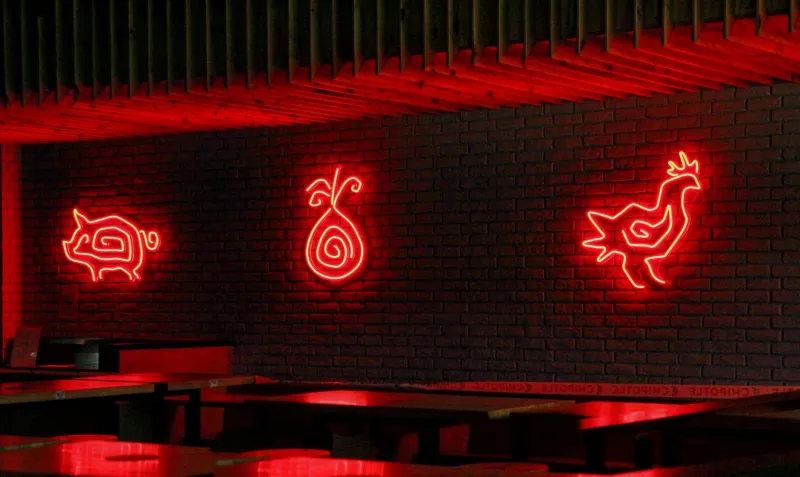
There's a moment when you walk into a certain kind of room and your brain does something unexpected — it recalibrates. The walls aren't just painted; they're glowing. The ceiling doesn't just shelter; it pulses. You're not standing in a restaurant or a lobby or someone's apartment. You're standing inside a feeling.
That feeling has a name, and right now it's being built into the bones of American spaces from coast to coast. Neon aesthetics — long associated with roadside signage, arcade culture, and the hypervisual language of digital art — have moved off the screen and into the architecture itself. And the designers behind this shift aren't treating it as a trend. They're treating it as a new vocabulary.
From Accent to Architecture
The distinction matters. For years, neon in interior design meant a fun sign above a bar or a pink tube light framing a mirror. Eye-catching, sure. But fundamentally cosmetic — something you could remove without changing the space.
What's happening now is structurally different. Designers are embedding light into the actual logic of a room: integrated into millwork, running through translucent wall panels, diffused behind perforated metal ceilings, and used to define spatial zones the way walls once did. The glow isn't added on top of the design. It is the design.
New York-based studio Superfutures has been at the forefront of this shift, building custom LED neon systems into residential projects across Brooklyn and Lower Manhattan. Co-founder Dana Reyes describes their approach as "emotional architecture." "We're not lighting a room," she told us. "We're programming a mood. The light is load-bearing in a psychological sense. It tells you how to feel the moment you cross the threshold."
That psychological dimension is key. Interior architects have always understood that light shapes perception — it controls how large a space feels, how warm or cold, how welcoming or austere. What the neon-forward movement adds to that conversation is color temperature as emotional signal. The deep magentas and electric blues that define the aesthetic aren't arbitrary. They're borrowed directly from the visual grammar of digital art, cyberpunk cinema, and the hyperlit world most Americans now spend a significant portion of their lives inhabiting through screens.
Miami and LA: The Labs of Luminous Design
If New York is where the intellectual framework is being built, Miami and Los Angeles are where it's being stress-tested in the wild.
Miami's dining and hospitality scene has become a genuine proving ground for neon-integrated interiors. Studio Luminos Arc, based in Wynwood, has designed a string of restaurant and lounge spaces that blur the line between physical room and immersive installation. Their work on Volta, a supper club in Miami Beach, replaced conventional ambient lighting entirely with a system of curved neon tubes embedded behind frosted acrylic panels, casting the entire dining room in a shifting gradient of violet and amber. Reservations reportedly book out weeks in advance — and more than a few guests admit the light is as much the draw as the menu.
"People want to be somewhere now," says Luminos Arc principal Marcus Vega. "Not just eat or drink somewhere. The space has to have its own identity, its own visual signature. Neon gives you that immediately. It's cinematic. It's specific. You know exactly where you are."
In Los Angeles, the influence of the entertainment industry runs deep through interior design culture, and it's no surprise that studios with roots in film and production design are leading the charge. Prism Studio LA — founded by production designer-turned-architect Keiko Tanaka — has applied a distinctly cinematic sensibility to residential and commercial spaces across Silver Lake, Echo Park, and West Hollywood. Tanaka's signature move is what she calls the "scene within a scene": a room designed so that every corner offers a different light story, the way a film set is lit to reward movement through the frame.
"I think about how the camera would see it," Tanaka explains. "But then I flip that — how does the person see it when they're the camera? When they're moving through the space? Neon is incredible for that because it has depth. It has atmosphere. It doesn't just illuminate; it implicates you in the environment."
The Digital World Comes Home
There's a broader cultural logic at work here that goes beyond aesthetics. Americans — especially younger millennials and Gen Z — have grown up navigating a visual world defined by screens, digital art, and the hyperchromatic environments of gaming, social media, and streaming. The neon palette isn't foreign to them. It's native.
Interior architect and design researcher Priya Holloway, who teaches at Parsons School of Design in New York, sees the neon interiors movement as a direct response to that reality. "There's a generation that has spent thousands of hours inside beautifully designed digital environments — game worlds, virtual spaces, algorithmically curated feeds," she says. "The physical world, by comparison, can feel visually flat. What neon-forward design does is close that gap. It says: your physical space can feel as alive and intentional as the digital spaces you love."
That bridge between physical and digital is also showing up in how these spaces are used. Designers like Reyes and Tanaka report that clients increasingly reference specific digital artworks, video game environments, or Instagram aesthetics when briefing them on a project. The conversation has shifted from "I want it to feel warm and welcoming" to "I want it to feel like you're inside a Beeple render" or "I want the vibe of that neon cityscape from Cyberpunk 2077."
The Technical Revolution Behind the Glow
None of this would be possible without a parallel revolution in the technology itself. Traditional glass neon — beautiful as it is — was fragile, expensive, and limited in its color range and flexibility. The emergence of high-quality LED neon flex has changed everything. Modern LED neon systems can be bent into virtually any form, integrated into architectural elements with minimal depth, programmed to shift color and intensity dynamically, and maintained without specialized artisan skills.
For interior architects, this has opened up a design space that simply didn't exist a decade ago. You can run a continuous neon element through a 40-foot ceiling, embed it behind a translucent stone wall, or program it to respond to music, time of day, or even occupancy. The light becomes interactive. The room becomes responsive.
"The technology caught up with the vision," says Marcus Vega. "We always knew what we wanted to create. Now we actually have the tools to create it."
What Comes Next
If the current trajectory holds, neon-integrated architecture is moving from statement spaces to something more pervasive — appearing in boutique hotels, corporate offices, healthcare environments, and everyday residential builds. Design forecasters are already talking about "ambient neon" as a standard specification option in high-end residential construction, the way smart home systems became standard a decade ago.
But the designers at the cutting edge of this movement are quick to caution against dilution. "When everything glows, nothing glows," Dana Reyes says simply. "The power of this aesthetic is in its intentionality. The light has to mean something. It has to be doing work — emotional, spatial, narrative work. The moment it becomes wallpaper, we've lost it."
For now, though, the spaces being created under this philosophy feel anything but wallpaper. They feel like somewhere worth being — vivid, deliberate, and alive in a way that purely material design rarely achieves. Like stepping, finally, into the digital dream you've been scrolling through your whole life.
And honestly? It looks even better in person.