The Festival as Canvas: How Neon Futurism Took Over America's Biggest Music Events
The Festival as Canvas: How Neon Futurism Took Over America's Biggest Music Events
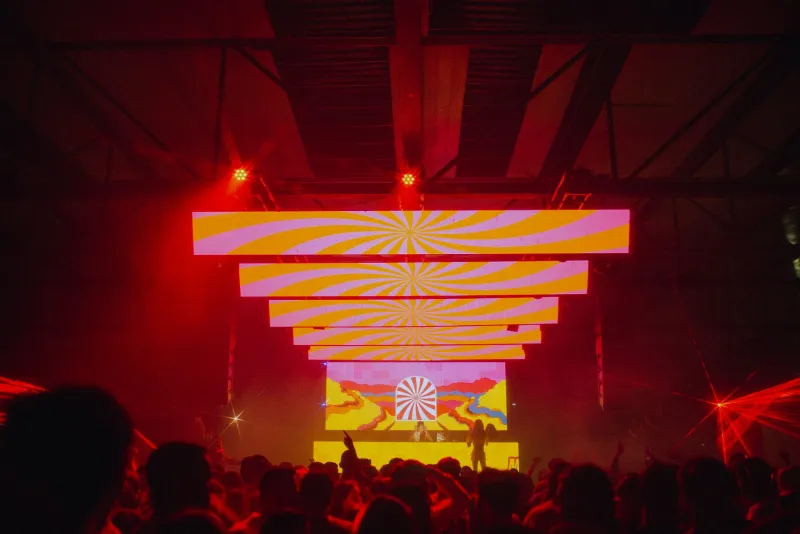
There's a moment at Electric Daisy Carnival — usually somewhere around 2 a.m., somewhere between the bass drop and the next one — when you stop thinking about the music and just look. Towering kinetic sculptures pulse in chromatic cycles. LED grids stretch across scaffolding like luminous wallpaper. Laser arrays slice the Nevada sky into geometric ribbons. For a second, it doesn't feel like a concert. It feels like you've walked into a piece of digital art that decided to become architecture.
That feeling isn't accidental. It's designed.
Over the past decade, America's biggest music festivals have quietly reinvented themselves as immersive visual experiences — and neon aesthetics are at the center of that transformation. What started as stage lighting has evolved into a full-blown design language: hyperdigital, retro-futurist, and deeply rooted in the glowing visual culture that NeonHyper exists to celebrate.
From Backdrop to Brand Identity
Ask anyone who attended Coachella in the early 2000s what the festival looked like, and they'll probably describe some dusty stages and maybe a giant tent. Ask someone who went in 2018 or 2019, and you'll hear about the LED-wrapped Ferris wheel, the art installations that trended on Instagram before most sets even started, and an overall visual palette that felt ripped straight from a cyberpunk concept board.
That shift wasn't just aesthetic drift — it was strategic. Festival organizers figured out, probably around the time Instagram became a cultural force, that visual identity is brand identity. Coachella doesn't just book headliners; it curates a look. The annual lineup of large-scale art installations — many involving neon light, LED arrays, and digitally designed sculptural forms — functions as a parallel programming track aimed squarely at the eyes.
Governors Ball in New York has taken a similar approach, leaning into a cleaner, more urban visual language that still traffics heavily in electric color and glowing geometry. The festival's stage design in recent years has embraced a kind of downtown-futurist aesthetic: sharp angles, vivid gradients, and lighting rigs that feel less like concert gear and more like interactive digital installations dropped into Randall's Island.
The Artists Building These Worlds
Behind every glowing arch and pixel-mapped LED tower is a creative team that most festival-goers never think about — but probably should.
Stage designers like Tribe Inc. and Moment Factory have become major players in the festival visual ecosystem, engineering environments that blur the line between concert production and immersive art installation. Moment Factory, whose work spans music festivals, theme parks, and public spaces, has developed a design philosophy that treats light as a sculptural medium. Their LED environments don't just illuminate performers — they create spatial narratives that respond to sound and movement in real time.
Smaller independent artists are making waves too. Digital visual artists who built followings on platforms like Instagram and Behance are increasingly getting tapped to design projection mapping sequences, animated stage backdrops, and neon-inflected environmental graphics. The festival circuit has become one of the few places where digital art escapes the screen entirely and gets rendered at genuine architectural scale.
For these artists, the appeal is obvious. "You're not designing something that lives in a browser tab," one festival visual director noted in a recent industry interview. "You're designing something that surrounds 100,000 people. The neon aesthetic works at that scale because it's inherently theatrical — it commands space."
Why Neon? Why Now?
It's worth asking why, out of all the possible visual directions festival design could have taken, neon futurism became the dominant aesthetic. The answer probably lives at the intersection of a few cultural currents.
First, there's the nostalgia factor. The neon sign, once the visual shorthand of American commercial culture — diners, motels, Vegas strip joints — carries a specific emotional frequency. It's warm and synthetic at once. It signals both a lost America and an imagined future. That tension is incredibly potent in a cultural moment where retrofuturism is everywhere from album covers to sneaker drops.
Second, there's the social media dimension. Neon-saturated environments photograph beautifully. High-contrast glow against dark backgrounds creates images that pop on any screen. Festival organizers know that every attendee with a smartphone is essentially a content creator, and designing spaces that generate compelling photos is now part of the ROI calculation. EDC's famous flower sculptures — massive, LED-lit kinetic structures that have become iconic visual symbols of the event — weren't just designed to be experienced in person. They were designed to be photographed, shared, and turned into the kind of imagery that makes people want to buy tickets next year.
Third, and maybe most importantly, neon aesthetics align naturally with the electronic music culture that dominates the festival landscape. The visual language of techno, house, and EDC — geometric, glowing, synthetic — maps directly onto neon's chromatic intensity and artificial warmth. The music and the visuals speak the same dialect.
The Festival as Living Gallery
What's emerging from all of this is something genuinely new in American cultural life: the music festival as a form of public art exhibition. Not a venue where art happens to be present, but a designed environment where visual experience is as central as sonic experience.
EDC's "art cars" — mobile stages that double as rolling sculptures — are a perfect example. These aren't just platforms for DJs. They're kinetic artworks that move through crowds, their LED skins cycling through visual programs designed by dedicated digital artists. Attending EDC and only watching the main stages would be a bit like going to MoMA and only looking at the lobby.
Coachella's installation artists — past participants have included large-scale work by artists exploring light, shadow, and digital form — are often given as much curatorial attention as the musical headliners. The installations are announced, discussed, and reviewed with the same seriousness as the music programming.
Governors Ball, working within the constraints of a more urban, compact site, has leaned into projection mapping and LED architecture to create visual density that compensates for the lack of open desert space. The result is a different flavor of neon futurism — tighter, more layered, almost like walking through a city that's been redesigned by someone who spent too much time playing Cyberpunk 2077.
What Comes Next
The trajectory seems clear: as projection technology gets cheaper, LED resolution gets higher, and digital artists get more integrated into festival production pipelines, the visual ambition of these events is only going to grow. There's already experimentation with AR overlays that let attendees use their phones to see additional animated layers superimposed on physical installations. The boundary between the physical neon environment and the digital one is getting genuinely blurry.
For fans of digital art and neon aesthetics, that's an exciting prospect. The festival is becoming one of the few spaces in American life where this visual culture gets to exist at full, uncompromising scale — not on a phone screen or a gallery wall, but all around you, overhead and underfoot, built from light and designed to make you feel like you're living inside a dream someone rendered at 4K.
And honestly? That sounds about right.