Last Exit for Neon: The Road-Trip Photographers Racing to Save America's Glowing Roadside Soul
Last Exit for Neon: The Road-Trip Photographers Racing to Save America's Glowing Roadside Soul
There's a particular kind of heartbreak that hits when you pull off a highway exit expecting to find a sign you've been chasing for three states — and discover a blank concrete wall where it used to stand. Ask any of the photographers quietly crisscrossing the American road network right now and they'll have a version of that story. Some have several. The loss stings not just because the image is gone, but because everything that sign carried — the decade it was built in, the family that ran the place, the travelers who stopped there — evaporated with it.
This is the world that a growing community of documentary and fine-art photographers has decided to fight against, one road trip at a time.
The Highway as Gallery
You don't need a gallery commission to understand what these shooters are doing. The American roadside — Route 66 snaking through New Mexico, the old US-61 corridor through the Mississippi Delta, the neon-studded strips of old Tucson and Albuquerque — has always been its own kind of open-air museum. The difference now is urgency.
Signs that were humming quietly through the 1990s and 2000s are disappearing at an accelerating clip. Energy codes, insurance costs, and the sheer cheapness of LED replacements have turned vintage neon into a liability for small business owners who can't afford restoration. Redevelopment swallows entire strips overnight. And when a sign goes dark for the last time, there's rarely a press release.
Photographers like Phoenix-based Daria Solano have built their entire practice around that uncomfortable reality. Solano has logged more than 40,000 miles over the past six years, specifically targeting independently owned motels, roadside diners, and drive-in theaters across the Southwest and Mountain West. Her archive now runs past 18,000 images — many of them documenting signs that no longer exist.
"I started because I thought it would be a personal project," she says. "Then I showed up to a place I'd been planning to shoot for months and it was just gone. That changed everything. I stopped thinking about aesthetics and started thinking about time."
What Makes a Sign Worth Chasing
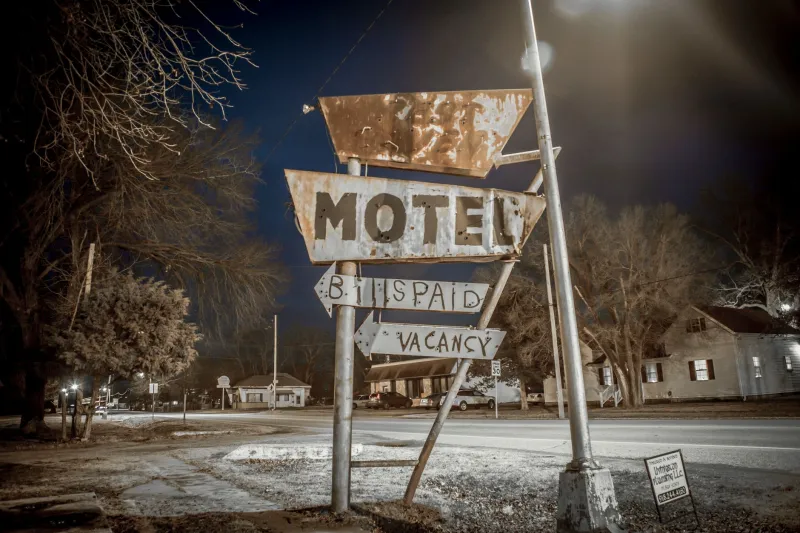
For the uninitiated, it might seem odd that a rusting arrow sign outside a 12-room motel in Gallup, New Mexico could carry serious cultural weight. But spend any time in this photography community and the logic becomes clear fast.
These signs are not just advertisements. They're artifacts of mid-century American optimism, handcrafted by local sign shops that no longer exist, designed for a car culture that was just hitting its stride. The neon tubing — bent by hand, filled with gas, wired to transformers — represents a level of local craft and individual expression that mass production has almost entirely displaced.
Chicago-based photographer Marcus Webb, who focuses on Midwest diner and drive-in culture, puts it this way: "Every one of these signs was made by someone who cared about it. The proportions, the font choice, the color combination — that was a real decision made by a real person for a specific place. You can feel that when you're standing in front of one at 2 a.m. with your camera."
Webb's ongoing series, which he's been posting to his website and a dedicated Instagram account, documents drive-in theater marquees from Indiana to Iowa. Several of the theaters he's shot have since closed. His photographs are now the only high-resolution visual record of some of those signs.
The Archive as Act of Resistance
What separates this movement from simple nostalgia photography is the deliberate archival intent behind it. Many of these photographers are coordinating — loosely, informally, mostly through online communities and shared Google Maps pins — to divide coverage of regions and flag signs that are in immediate danger.
Some are working with local historical societies and preservation nonprofits to donate high-resolution scans and location data. Others have partnered with university libraries that are building digital archives of vernacular American signage. A few have connected with the Society for Commercial Archeology, one of the oldest organizations dedicated to preserving roadside commercial culture in the US.
The photography itself functions on two levels simultaneously. As pure documentary work, it creates records that historians, preservationists, and future researchers can actually use. But as visual art — and make no mistake, the best of this work is genuinely striking — it also builds public emotional investment in things that bureaucracies tend to treat as expendable.
Solano's prints, when she exhibits them, are large. Deliberately so. "I want people to stand in front of a four-foot image of a motel sign in the rain and actually feel something," she says. "Because if you feel something, maybe you care. And if you care, maybe the next time someone proposes tearing one of these down, there's a little more friction."
Neon After Dark: The Technical Obsession
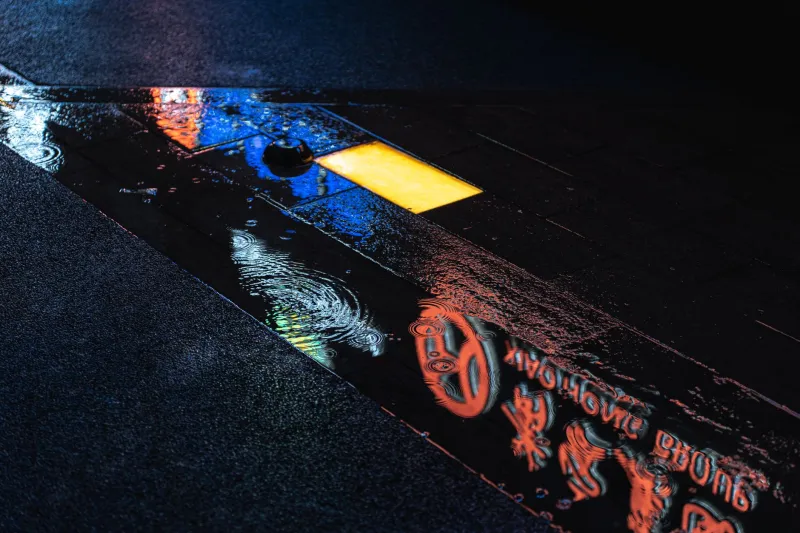
There's also a purely photographic dimension to this work that deserves attention on its own terms. Shooting neon at night — capturing the way a sign bleeds color into wet asphalt, halos against a dark sky, or competes with the orange wash of sodium streetlights — is genuinely difficult. It demands long exposures, careful white balance decisions, and an intuitive sense of when the ambient light is doing something interesting rather than just blowing out the frame.
Many of these photographers have developed highly specific techniques. Some shoot exclusively during the "blue hour" just after sunset, when there's still enough ambient light to render the surrounding environment but neon signs are already at their most vivid. Others prefer full darkness, leaning into the way neon isolates itself against nothing. A few specialize in rain — wet surfaces multiply and distort neon reflections in ways that can turn a simple roadside sign into something that looks like a fever dream.
Webb describes his process as "slow and deliberate in a way that feels almost out of step with everything else." He typically scouts locations during the day, returns after dark, and spends anywhere from thirty minutes to two hours working a single sign from different angles and distances. "You're not just documenting the sign," he explains. "You're documenting the sign's relationship to everything around it — the parking lot, the sky, the road. That relationship is what makes it feel like America."
Why This Matters Right Now
It would be easy to frame this as pure preservation work — important but essentially backward-looking. That reading misses something. The photographers driving these highways aren't just mourning the past. They're making an argument about what visual culture should value.
In an era when digital design has made aesthetics infinitely reproducible and almost infinitely cheap, there's something genuinely radical about insisting that a hand-bent neon arrow sign outside a family-run motel in rural New Mexico is worth three days of driving to photograph. It's a position that says craft matters, that place matters, that the specific and unrepeatable are worth more than the generic and efficient.
That argument resonates with the broader NeonHyper ethos — the idea that glowing light, whether it's a vintage roadside sign or a contemporary digital artwork, carries emotional charge that flat, cold illumination simply can't replicate. These photographers aren't just chasing signs. They're chasing proof that some things glow because they were made with intention, and that intention is worth preserving.
The highway doesn't wait. Neither do they.