Built to Burn Bright: The American Architects Treating Light as a Load-Bearing Material
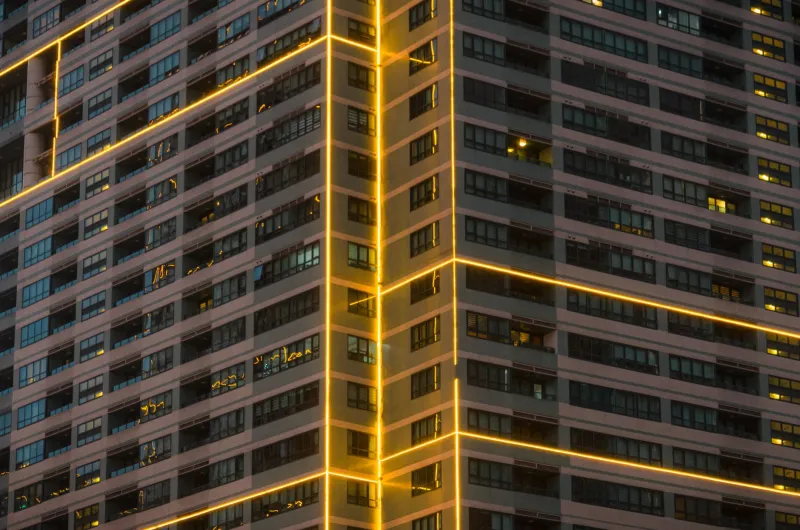
There's a moment, usually somewhere around 9 p.m., when a building stops being a building and starts being something else entirely. For most structures, that moment is unremarkable — a few floodlights kick on, some windows go yellow, and the whole thing retreats into the urban background. But a new wave of American architects is refusing to let that happen. They're designing buildings where the night shift is the main event, where luminous materials aren't bolted on at the end of a project but woven into the very concept from day one.
This isn't about neon signage slapped onto a facade or LED strips used to outline a roofline. What's emerging from studios in Miami, Austin, Seattle, and beyond is something more radical — an architectural philosophy where electroluminescent panels, fiber-optic concrete, and gas-discharge tubing function the way steel and glass always have: as essential, expressive, load-bearing ideas.
The Shift From Decoration to Structure
For decades, architectural lighting lived in a separate conversation from architectural design. You hired the structural engineers, the facade specialists, the interior designers — and then, almost as an afterthought, you brought in the lighting consultants to make it all look good after dark. The results were often fine. Sometimes even beautiful. But they were fundamentally cosmetic.
What's changing now is the sequence. A growing number of studios are starting with the question of light — how does this building emit, absorb, and interact with luminous energy — before they've decided on a single material or structural system. Light becomes the brief, not the finish.
This shift has been accelerated by a new generation of materials that make it physically possible. Translucent concrete embedded with fiber-optic threads. Electroluminescent film thin enough to laminate between glass panels. Flexible neon tubing that can be bent into any radius a facade demands. Phosphorescent aggregates that charge during the day and release slow, ghostly glows through the night. The toolkit has expanded dramatically, and architects who grew up aesthetically fluent in neon culture — who came of age watching cyberpunk cinema and playing games like Cyberpunk 2077 — are picking it up with genuine excitement.
Miami: Where the Heat Meets the Hum
Miami has always had a complicated, electric relationship with light. The Art Deco pastel glow of South Beach, the hot-pink signage of Wynwood's gallery district, the way the whole city seems to vibrate at a slightly different frequency after sundown — it's a place that was practically pre-wired for this movement.
Several studios working out of the city's Design District are now completing projects where electroluminescent panels replace conventional cladding on commercial and mixed-use buildings. The effect is less "lit up" and more "internally alive" — surfaces that seem to generate their own soft luminescence rather than reflect light thrown at them from outside. One recently completed mid-rise near Brickell uses layered translucent panels with embedded EL wire in shifting blue-green gradients that respond to ambient temperature data, meaning the building literally reads the Miami heat and translates it into color. It's architecture as feedback loop.
Austin: The Tech Corridor Gets a Soul
Austin's rapid growth has produced a skyline that critics have been unkind about — a lot of glass boxes chasing density without much personality. But the same tech-forward culture that drove that growth is now funding something more interesting. Several studios working in the city's east side and along the Second Street District are experimenting with what they're calling "active facades" — building skins that incorporate programmable neon and EL elements not as displays but as textural, atmospheric surfaces.
The distinction matters. These aren't buildings that show you things — no scrolling advertisements, no pixel-mapped light shows. Instead, the luminous elements function more like the grain of a material, the way wood has figure or stone has veining. The glow is present, ambient, and deeply tied to the physical form of the building. One studio has been working with custom-bent neon tubing integrated into the structural fins of a mixed-use development, the tubes running vertically the full height of the building like glowing rebar made visible. At street level, you walk past it the way you'd walk past a waterfall — aware of something alive nearby.
Seattle: Glow in the Rain
If Miami is about heat and Austin is about energy, Seattle's version of this movement is something quieter and stranger. The city's perpetual overcast and constant rain create a different kind of canvas. Surfaces are always wet. Light scatters differently. The sky rarely goes fully dark — it just goes a deeper, more saturated gray.
Architects working in Capitol Hill and South Lake Union have been leaning into this atmospheric weirdness rather than fighting it. Electroluminescent panels in deep violet and amber tones that would read as garish in direct sunlight become something almost painterly when diffused through Seattle rain. One recently permitted project in the Capitol Hill neighborhood incorporates phosphorescent aggregate into its exterior concrete mix — the building charges during whatever daylight it gets and then releases that energy slowly through the night, glowing with a faint, organic luminescence that shifts as the concrete weathers and ages over time. It's a building designed to look better at ten years old than it does at opening day.
The Challenges Nobody's Talking About Enough
For all the excitement, this movement has real friction points that its practitioners are candid about. Building codes in most American cities were not written with luminous facades in mind, and getting permits for structures that incorporate active light-emitting materials into their envelope can be a months-long conversation with municipal authorities who aren't sure which category any of it falls into. Is it signage? Is it a lighting installation? Is it a structural element? The answer is usually "all three," which is exactly the kind of answer that makes permitting offices nervous.
Maintenance is another honest conversation. Conventional building materials — concrete, glass, steel — are understood. Their failure modes are documented, their lifespans are predictable. Electroluminescent films, neon gas-discharge tubes, and fiber-optic concrete are all newer in the context of exterior building applications, and the long-term data on how they hold up against UV exposure, temperature cycling, and moisture infiltration is still being written in real time.
And then there's cost. These materials and the expertise to integrate them properly are not cheap. Right now, this movement is largely confined to commercial projects, cultural buildings, and high-end mixed-use developments with clients who can absorb the premium. Whether it ever filters down to the broader housing market is an open question.
What a Building Is Allowed to Feel Like
But here's what makes this movement worth watching regardless of those friction points: it's asking a genuinely interesting question about what architecture is for. Buildings have always communicated — through scale, material, proportion, and position. What this generation of architects is proposing is that light is simply another language in that vocabulary, and that the night is a design surface as legitimate as any facade.
When you walk past a building that glows from within — not lit from outside, not displaying anything, just present and luminous and alive — something shifts in how you understand the city around you. The boundary between the built environment and the experiential one gets softer. The skyline stops being a silhouette and starts being something you can almost hear.
That's the dream these architects are chasing. Not buildings that look good in photographs. Buildings that change how it feels to be outside after dark in an American city. Given what they're building, it's a dream worth staying up for.