Time in Neon: How Independent American Watchmakers Are Charging Fine Horology With Electric Light
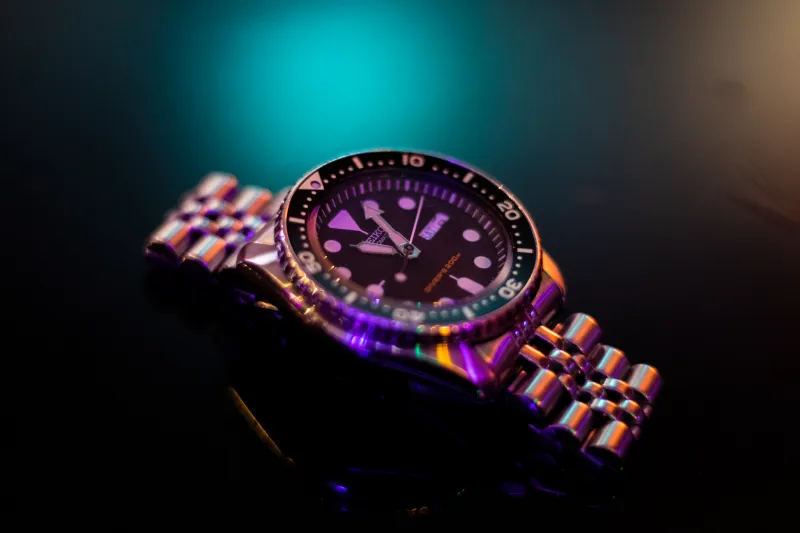
There's something almost poetic about a watch. It lives on your wrist, right up against the pulse. It's the most personal canvas a designer can work with — smaller than a phone screen, more intimate than a tattoo, and visible every time you glance down to check if you're late. For most of horology's history, that canvas has been dominated by tradition: Swiss precision, muted dials, leather straps, and the quiet authority of old money.
But something's shifting. A loose network of independent American watchmakers and micro-brands is rewriting the rules, pulling the aesthetic vocabulary of neon culture, cyberpunk visual identity, and digital art directly onto the dial. These aren't novelty pieces or costume jewelry. They're serious, precision-built timepieces that happen to glow, pulse, and radiate the same electric energy you'd expect from a neon installation in a Brooklyn gallery or a late-night strip in downtown LA.
The Dial as a Light Source
For most collectors, lume — the luminescent material applied to watch hands and indices so you can read the time in the dark — is a practical afterthought. For this new generation of designers, it's the whole point.
Take Detroit-based micro-brand Voltnite Watch Co., which launched in 2021 with a single model featuring a fully lumed "supernova" dial. The entire surface was treated with Swiss Super-LumiNova in layered gradients — deep violet at the edges bleeding into electric teal at the center. In daylight, it reads as a sophisticated ombre effect. In the dark, it becomes something else entirely: a wearable piece of neon art that charges from ambient light and glows for hours.
"We weren't thinking about watch collecting when we started," says founder Marcus Delray. "We were thinking about what it would look like to wear a piece of the city at night. That feeling of walking past a neon sign and having the color hit you — we wanted that on your wrist."
Delray's background is in industrial design, not watchmaking, and that outsider perspective shows. Voltnite dials are structured more like graphic compositions than traditional watch faces, with asymmetric sub-dials and typographic hour markers that feel closer to streetwear branding than anything coming out of Geneva.
Cyberpunk Craft
Across the country in Portland, Oregon, Aurelius Flux — a one-person operation run by watchmaker and visual artist Soren Kael — is doing something even more radical. Kael hand-builds each watch to order, using custom-milled cases in grade 5 titanium and dials fabricated from materials you wouldn't normally find anywhere near a movement: carbon fiber laced with photoluminescent resin, translucent sapphire layers over illuminated circuit-board patterns, and in one limited series, dials etched with ultraviolet-reactive ink that only fully reveals its design under a black light.
"The Swiss tradition is incredible — I have enormous respect for it," Kael says. "But it's also very conservative. There's a whole visual universe happening in digital art, in neon culture, in the way people are thinking about light and color right now, and fine watchmaking has been almost completely absent from that conversation. I want to be in that conversation."
Kael's pieces start at around $3,800 and routinely sell out within hours of announcement, almost entirely through Instagram and a tight-knit Discord community. The buyers skew younger than traditional watch collectors — mid-20s to late-30s, often with backgrounds in tech, design, or creative industries — and many describe the pieces less as investments and more as wearable art.
Streetwear Meets the Movement
The crossover between streetwear culture and fine horology isn't new — collaborations between luxury watch brands and sneaker labels have been happening for years. But what's different about this American micro-brand movement is that the influence isn't superficial. It's not a colorway swap or a branded buckle. The aesthetic runs all the way down to the movement architecture.
New York-based brand Gridlock Time launched last year with a model called the PRISM-01, featuring a skeleton dial that exposes the movement through a color-shifted sapphire crystal tinted in electric blue. The hands are coated in a custom green lume formula that the brand developed with a specialty photoluminescent materials lab in New Jersey. The result is a watch that looks, in certain lighting, like a miniature neon sign strapped to your arm.
"We're not trying to out-Swiss the Swiss," says Gridlock co-founder Amara Osei. "We're coming from a completely different place. We grew up on sneaker culture, on streetwear drops, on digital art and gaming aesthetics. The watch is just where all of that landed for us."
Osei is quick to point out that the design ambitions don't come at the expense of technical quality. The PRISM-01 runs on a Swiss ETA movement, is rated to 100 meters water resistance, and carries a sapphire crystal front and back. "We wanted the glow to be the hook, but we wanted the watch to actually be good," she says.
A Cultural Statement on the Wrist
What makes this movement genuinely interesting from a cultural standpoint is what it says about where futurist visual identity is going. For years, the neon aesthetic lived primarily in digital spaces — on screens, in video games, across social media feeds. Then it migrated to physical environments: gallery installations, festival stages, architectural lighting. Now it's arriving at the most intimate physical space of all: the human body.
A watch isn't just an accessory. It's a statement about who you are and what you value. When someone straps on a Voltnite or an Aurelius Flux piece, they're not just telling the time. They're signaling an entire aesthetic worldview — one that values futurism over tradition, vibrancy over restraint, and individual creative vision over institutional prestige.
That's a genuinely new thing in the watch world, and it's happening almost entirely outside the established industry infrastructure. No trade show booths, no authorized dealer networks, no full-page ads in luxury magazines. Just direct-to-consumer drops, community-built hype, and a design language that resonates deeply with audiences who grew up staring at neon-lit screens.
The Glow Is Just Getting Started
The Swiss establishment has started paying attention, even if it hasn't quite figured out what to make of it. Several major brands have quietly released "neon" limited editions in recent years — bold dial colors, high-visibility lume treatments — but most watch collectors agree these feel more like trend-chasing than genuine creative commitment.
The American micro-brands aren't worried about that. They're moving faster than any corporate design process can follow, iterating in real time with their communities and pushing materials and aesthetics into territory that established brands simply can't go.
"In five years, I think the conversation about American watchmaking is going to sound completely different," Delray says. "Not because we beat the Swiss at their own game, but because we changed the game entirely."
For anyone paying attention to where neon culture is heading, that sounds about right. The glow that started on city walls and gallery screens has found its way to the wrist — and it's not going anywhere but brighter.