Step Inside the Glow: How Immersive Theater Is Turning Electric Light Into a Full-Body Experience
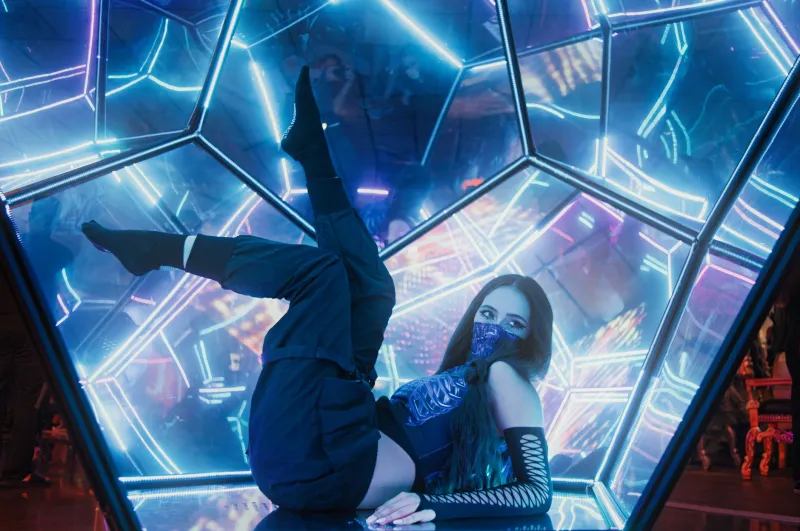
There's a moment that keeps getting described by people who've walked through one of these productions. You push through a heavy curtain or a rusted door, and suddenly — before a single performer says a word, before the narrative makes any sense at all — the light hits you. Pink and violet and cold electric blue. Tubes of neon running along cracked concrete walls. Fog pooling at your ankles. The air itself feels charged. And something in your chest does something unexpected.
That's the whole game for a growing cluster of American immersive theater companies who are borrowing aggressively from neon futurism and cyberpunk visual language to build environments that don't just host a story — they become one. What used to be a fringe festival experiment has quietly evolved into one of the more exciting intersections of digital art culture and live performance happening anywhere in the country right now.
Beyond the Black Box
The shift starts with the space itself. Traditional theater asks you to sit in the dark and look at a lit stage. Immersive work flips that contract completely — the audience moves through a fully realized environment, and the lighting design isn't there to illuminate performers. It's there to construct a world from scratch.
Companies like New York's Third Rail Projects, whose long-running Then She Fell transformed a former psychiatric facility into something genuinely haunting, helped establish the template. But a newer generation of collectives is pushing the aesthetic further into neon-futurist territory, trading Victorian gothic for something that looks more like a fever dream set inside a Blade Runner outtake.
Los Angeles-based Delusion, founded by Jon Braver, has been producing large-scale horror-adjacent immersive experiences since 2011, but recent iterations have leaned harder into industrial neon palettes — flickering fluorescents, glowing signage, color-gelled corridors that feel ripped from a cyberpunk graphic novel. Braver has talked openly about treating each production like a film set, which means every lighting choice carries narrative weight. The glow isn't decoration. It's exposition.
The Warehouse as Canvas
Vacant real estate has become an unlikely creative resource for this movement. Parking structures in downtown Chicago, decommissioned factories in Detroit, empty retail floors in Houston — these raw, industrial spaces have an architectural honesty that traditional venues can't fake. And they absorb neon aesthetics in a way that feels almost inevitable.
When Punchdrunk — the UK-born company that essentially invented the modern immersive format with Sleep No More, still running in New York after more than a decade — floods a multi-story warehouse with color-coded light environments, each floor carrying its own chromatic identity, it's doing something that goes well beyond mood-setting. The lighting geography becomes a map. Audiences learn to read the color of a room the way they'd read a chapter heading.
Smaller regional companies are taking similar approaches with tighter budgets and scrappier instincts. Chicago's WildClaw Theatre and experimental collectives operating out of cities like Austin, Portland, and Philadelphia have been quietly building site-specific work that treats neon and LED installations as primary storytelling tools rather than afterthoughts. The aesthetic vocabulary — electric signage, color gradients, light that seems to pulse with its own heartbeat — is borrowed partly from digital art culture, partly from the visual grammar of contemporary video games, and partly from the long American tradition of the roadside neon sign as emotional shorthand.
Why Bodies in the Room Still Matter
It's worth asking why this is happening now, when audiences can access neon-soaked cyberpunk worlds through a screen in their pocket. The answer, according to most of the directors and designers working in this space, is precisely because screens are everywhere.
There's a physical irreducibility to standing inside a glowing environment that no display technology has managed to replicate. When the light is actually in the room with you — when it's bouncing off your skin and catching the faces of strangers moving through the same space — something neurological happens that passive viewing doesn't trigger. You're not consuming an aesthetic. You're inhabiting one.
Director and experience designer Tara Knight, whose company has produced site-specific work in unconventional LA venues, describes it as "the difference between looking at a painting of the ocean and getting your feet wet." The neon-futurist aesthetic amplifies this effect because it's inherently about charged atmosphere. It's a visual language built around intensity and immersion — which means it translates into physical space with unusual power.
The Storytelling Stakes
None of this would matter much if the aesthetic choices weren't serving actual narratives. The best work in this space uses the neon-drenched environment to externalize interior states — characters whose emotional lives are literally written in light and shadow across the walls around them.
Productions that have drawn the most attention tend to use the cyberpunk palette to explore themes of surveillance, identity, corporate control, and human connection under duress. These aren't accidental alignments. The visual language of neon futurism carries cultural freight — it evokes late-capitalism anxiety, the beauty and menace of the technologized city, the way artificial light can simultaneously comfort and unsettle. Audiences in 2024 arrive pre-loaded with those associations, and smart productions lean into them.
There's also something democratizing about the format. When the audience moves freely through a space, they co-author the experience. Two people can attend the same production and encounter completely different scenes, different performers, different emotional arcs. The neon environment becomes a shared dreamscape that each person navigates individually. That's a fundamentally different relationship to storytelling than anything a screen can offer.
What Comes Next
The movement is still finding its edges. Production costs for large-scale immersive work remain significant, and not every city has the infrastructure — or the appetite — to support it consistently. But the appetite among audiences is clearly there. Tickets for major productions sell out fast, often months in advance, and the social media afterlife of these experiences (people want to photograph themselves inside neon-lit environments, it turns out) has become its own form of marketing.
More interesting is the cross-pollination happening between immersive theater and the broader digital art world. Projection mapping artists, LED installation designers, and generative visual artists are increasingly collaborating with theater directors, bringing tools and sensibilities from gallery and festival contexts into live narrative work. The results are pushing both fields somewhere genuinely new.
For audiences who've grown up with screens as the default frame for visual experience, stepping into a warehouse that's been transformed into a glowing, electric, fully navigable world feels less like theater and more like climbing inside a piece of digital art. Which is, increasingly, exactly the point.