Saved by the Glow: Inside America's Mission to Rescue Vintage Neon Before It Disappears Forever
Saved by the Glow: Inside America's Mission to Rescue Vintage Neon Before It Disappears Forever
There's a particular kind of heartbreak that happens when a vintage neon sign hits the dumpster. Maybe it's the ghost of a mid-century motel that got bulldozed for a parking structure. Maybe it's the blazing script of a diner that fed three generations of a neighborhood before a rent hike finally shut it down. Whatever the story, when that glass tubing shatters and the argon escapes into the air, something genuinely irreplaceable goes with it.
Fortunately, a growing number of institutions across the United States have decided that "irreplaceable" is exactly the point — and they're doing something about it.
The Guardians of the Glow
The Museum of Neon Art in Los Angeles — affectionately known as MONA — is probably the highest-profile player in this space, but it's far from the only one. Cincinnati's American Sign Museum houses one of the most comprehensive collections of commercial signage in the world, spanning hand-painted wooden boards all the way through the golden era of neon and into the plastic-lit present. Meanwhile, the Neon Museum in Las Vegas has built an entire outdoor campus — the Boneyard, they call it — where massive casino signs rest against each other like luminous ruins from a civilization that ran on showmanship and electricity.
What connects these institutions isn't just a shared love of glowing glass. It's an urgent awareness that time is working against them. Neon signs from the 1930s through the 1980s are deteriorating in warehouses, rotting on rooftops, and getting scrapped by property owners who have no idea what they're throwing away. The window to save them is closing fast.
"Every month we hear about another sign that's gone," says one MONA volunteer restoration technician who has spent years learning the dying craft of neon bending. "It's not dramatic — it just quietly disappears, and then it's gone from the record entirely."
What Makes a Neon Sign Worth Saving?
The short answer is: almost all of them. But the curatorial process is genuinely complex. Restoration teams assess signs based on historical significance, artistic craftsmanship, geographic origin, and the story embedded in the design itself. A hand-bent script sign from a 1950s roadside motor court in Route 66 country carries different weight than a mass-produced franchise logo from the 1970s — though both tell you something real about American commercial culture at specific moments in time.
The American Sign Museum in Cincinnati leans hard into that historical framing. Their collection walks visitors through the full arc of American signage as a design discipline, treating neon not as kitsch but as a legitimate visual language that shaped how entire generations understood branding, place, and identity. Curators there have argued — convincingly — that the neon sign is as much a piece of American design history as a Eames chair or a WPA poster.
At MONA, the emphasis tilts more toward fine art. The museum has long positioned electric and neon art as a serious contemporary medium, hosting living artists alongside vintage pieces and blurring the line between preservation and active creation. It's an approach that gives the collection a forward-looking energy that pure nostalgia museums sometimes lack.
The Craft Behind the Rescue
Restoring a vintage neon sign isn't like patching a painting. The glass tubing is fragile, the original gas mixtures are sometimes impossible to replicate exactly, and the electrical components are often decades past their safe operating life. Skilled neon benders — the artisans who shape heated glass tubes into letterforms and decorative shapes — are themselves a threatened species. The trade peaked mid-century and has been contracting ever since, which means restoration teams are often learning on the job, reverse-engineering techniques that were never formally documented.
Some museums have responded by building active training programs. MONA, for instance, offers neon bending classes to the public, turning the preservation effort into a living craft revival. It's a smart move that serves multiple purposes at once: it generates revenue, builds community, and ensures that the knowledge needed to maintain the collection doesn't retire along with the last generation of master benders.
The tools of the trade — ribbon burners, crossfires, bombarding transformers — are increasingly hard to source, and the supply chain for specialty glass has thinned considerably over the decades. Every restoration is a small act of problem-solving, and the people doing this work have developed an almost obsessive intimacy with the medium.
A Younger Audience Is Paying Attention
Here's the thing that's genuinely surprising about the neon preservation scene right now: it's pulling a crowd that has no personal memory of these signs in their original context, and loving it anyway.
Visit MONA or the Neon Museum's Boneyard on any given weekend and you'll find a significant contingent of visitors in their twenties and thirties, phones out, absolutely losing it over the aesthetic. And this isn't purely ironic appreciation or Instagram-bait behavior — though there's plenty of that too. There's a real hunger for tactile, analog beauty in a design culture that has spent years drowning in flat design and algorithmic smoothness.
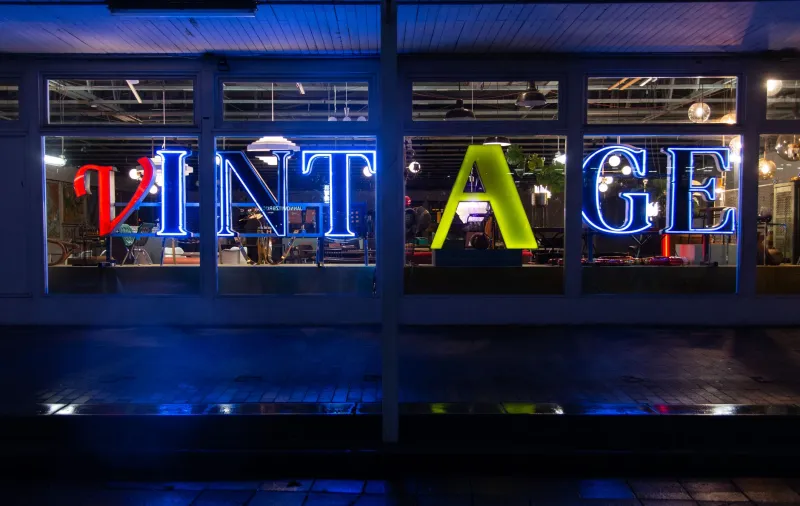
Vintage neon delivers something that a screen literally cannot replicate: the warm, slightly imperfect glow of ionized gas inside hand-shaped glass, the faint hum of a transformer, the way the light shifts when you move around it. For an audience that has grown up consuming digital aesthetics — including the neon-influenced visual language of cyberpunk games, synthwave album art, and vaporwave meme culture — encountering the real thing carries a kind of revelatory charge.
Museums have been smart about leaning into this connection. Many now host evening events where the signs are lit in full darkness, creating an atmosphere that feels less like a history lesson and more like stepping inside a dream you've already had. It's experiential in exactly the way contemporary audiences respond to, and it reframes the preservation mission as something alive and relevant rather than dusty and elegiac.
Tension in the Tubes
Not everyone is comfortable with the direction things are heading. Some preservationists worry that the Instagram-friendly packaging of neon history risks flattening it — turning complex stories about labor, commerce, and urban change into a vibe. A sign that once marked a Black-owned business in a segregated city, or a labor union hall, or a mom-and-pop shop that got crushed by a chain store carries history that doesn't always fit neatly into an aesthetic experience.
The best institutions are grappling with this honestly. The American Sign Museum in particular has worked to contextualize its collection within broader narratives of American commercial and social history, acknowledging that the roadside landscape these signs once populated was shaped by forces — racial covenants, highway construction, urban renewal — that weren't neutral or benign.
That tension between the beauty of the object and the complexity of its context is exactly what makes neon preservation interesting as a cultural project. These aren't just pretty things. They're evidence.
The Glow Must Go On
The race to save America's vintage neon is far from won. Signs continue to disappear faster than institutions can acquire and restore them, and funding for this kind of work is perpetually precarious. But the movement is real, it's growing, and it's finding allies in unexpected places — from design-school graduates who want to learn bending to tech workers who want to fund acquisitions to cities that are beginning to recognize historic signage as part of their cultural infrastructure.
At its core, the neon preservation movement is an argument about what counts as art, what counts as history, and whose commercial culture deserves to be remembered. The answer these museums keep arriving at is: more of it than we thought, and sooner than we expected.
The tubes are humming. The argon is still alive. And for now, the glow goes on.