The Beauty in the Breakdown: American Artists Are Falling in Love With Neon That Doesn't Work Right
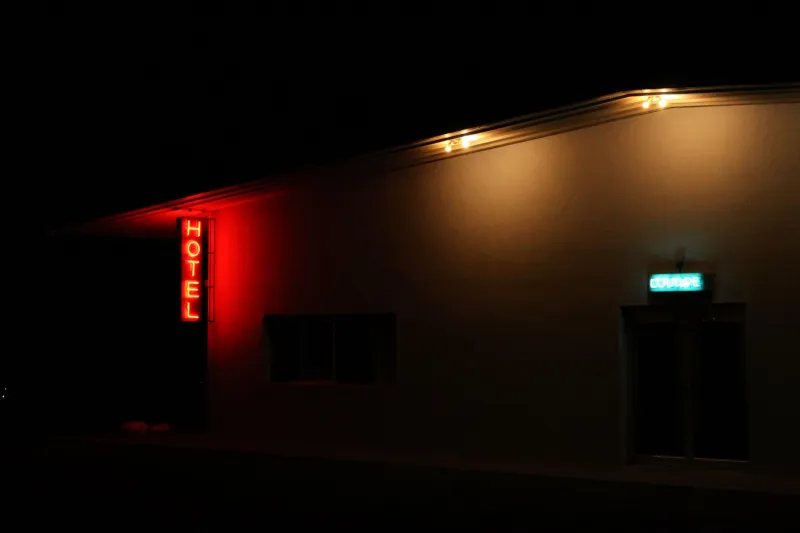
Let's start with a sign. It's outside a motel somewhere in the American interior — the kind of place that shows up in road-trip photography and crime dramas and the back of your mind when you're driving somewhere unfamiliar after dark. The sign once said something complete. Now it says something fractured. A letter has gone dark. Two more flicker at irregular intervals. The remaining elements glow steadily, oblivious.
For most of the sign's functional life, this was called failure. For a growing number of American artists, it's called a starting point.
The glitch aesthetic — the embrace of malfunction, deterioration, and visual instability as intentional artistic choices — has been a thread in digital art and graphic design for over a decade. But something is happening specifically to neon right now, something that feels distinct from the broader glitch conversation: artists are not just referencing broken neon visually, they're physically breaking it, deliberately destabilizing it, and presenting the result as finished work. And audiences are responding with a depth of feeling that polished, functional neon rarely generates.
What Malfunction Actually Looks Like as Art
The techniques vary, but the intent is consistent: introduce instability and let it generate meaning.
Chicago-based artist Renata Voss has been working with deliberately compromised neon for about three years. Her process involves sourcing functional vintage signage — the kind of mid-century commercial neon that still surfaces at estate sales and sign auctions — and then methodically degrading specific components. She'll introduce resistance variations that cause irregular flickering. She'll partially exhaust the gas in a tube to create color shift and dimming. She'll crack electrode seals in controlled ways that allow the discharge pattern to become unpredictable.
"People always ask if the work is 'broken,'" Voss says. "I say yes, intentionally. The break is the work. I'm not interested in signs that say what they were built to say. I'm interested in signs that say something they weren't supposed to."
What those signs end up saying is often surprisingly legible. A motel sign with its 'vacancy' partially extinguished reads differently than it did when fully lit — the remaining letters accumulate new meaning, sometimes poetic, sometimes darkly funny, frequently both. A restaurant sign cycling through failure modes starts to feel like an organism in distress. A neon sculpture that flickers between readable and unreadable states forces the viewer into a relationship with uncertainty that static art can't replicate.
The Anxiety Underneath the Flicker
It would be easy to frame the broken neon movement as purely formalist — artists exploring what the medium can do when you remove the constraint of functionality. But the artists themselves tend to describe something more emotionally loaded than that.
"We live in this culture of relentless optimization," says Marcus Okafor, a New Orleans-based sculptor who has shown deteriorating neon work in galleries from Atlanta to Portland. "Everything is supposed to work better, load faster, be more seamless. And there's this collective exhaustion with that. When something breaks in an interesting way, it feels honest. It feels like the thing is telling you the truth about its condition."
That resonance with American anxieties about technology and authenticity is hard to miss. At a moment when digital interfaces are increasingly designed to be frictionless and AI-generated content is raising questions about what's real and what's fabricated, a neon tube that visibly struggles — that shows its age, its wear, its resistance to functioning as intended — carries a kind of credibility that pristine work doesn't.
There's also a temporal dimension. Neon's deterioration is legible in a way that digital decay isn't. A glitching screen could be a hardware problem or a software issue or a designed effect — it's hard to read the cause from the surface. A deteriorating neon tube tells you its own history. The color shift says something about gas composition over time. The flicker pattern carries information about electrode wear. The physical object is honest about what it's been through.
Galleries Take Notice, Collectors Follow
For a while, broken neon occupied an uncomfortable middle ground in the art market — too conceptual for the commercial sign world, too craft-adjacent for galleries that wanted clean white-cube work. That's changing.
Several mid-tier American galleries have mounted dedicated shows around deteriorating and glitch-forward neon in the past two years. The reception has been strong enough to attract collector attention, which has in turn encouraged more artists to work seriously in the mode.
The pricing conversation is its own kind of interesting. Functional neon sculpture has an established market logic — size, complexity, materials, artist reputation. Broken neon complicates that calculus. Part of what you're buying is instability. The work will continue to change after purchase, because the deterioration process doesn't stop when money changes hands. Some collectors find that unsettling. Others find it exactly right.
"I bought a piece knowing it would look different in five years," says a Los Angeles-based collector who asked not to be identified. "That's part of why I wanted it. It's the only thing in my collection that's actually alive."
The Question of Intention
The movement is not without its critics, and the pushback is worth taking seriously. The most substantive objection is about the distinction between found deterioration and manufactured deterioration — between a sign that has genuinely aged and one that has been artificially aged by an artist who wants the aesthetic without the history.
Is there a meaningful difference between a fifty-year-old motel sign that flickers because it's genuinely worn and a gallery piece that flickers because an artist engineered it to? Some say no — the visual and emotional effect is equivalent, and art has always involved artifice. Others argue that the authenticity of actual deterioration is precisely what makes found and salvaged broken neon powerful, and that manufacturing the effect is a kind of simulation that undermines the point.
Voss has thought about this a lot. Her answer is careful: "I'm not pretending my work has aged naturally. Anyone who looks closely can see the interventions. The artifice is visible. What I'm doing is more like a translation — I'm taking what broken neon communicates and finding a way to say it intentionally. It's still a true thing, just said on purpose."
Maybe that's the most American thing about this whole movement: the insistence that you can manufacture authenticity if you're honest about the manufacturing. Whether that's a contradiction or a creative solution probably says more about the viewer than the work.