No Glass Required: How Gen Z Is Completely Reinventing What Neon Even Means
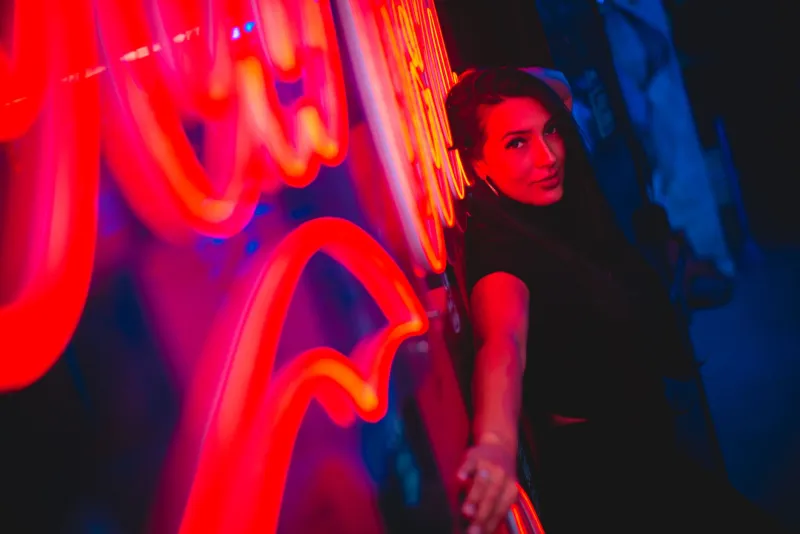
Ask a traditional neon craftsperson what they think of LED flex neon and you'll get one of two reactions. Either a long pause followed by a carefully diplomatic answer, or a very short, very direct one. The tension between old-school glass tube work and the new generation of neon alternatives is real, ongoing, and genuinely interesting — because both sides are right about something important.
On one side: a craft tradition stretching back over a century, built on the physical skill of bending heated glass, the chemistry of noble gases, and the irreplaceable warmth of a tube that's actually glowing from the inside out. On the other: a wave of young American creators who couldn't afford glass-tube equipment, couldn't find apprenticeships, and decided to build their own version of neon anyway — using materials that cost a fraction of the price and tools that fit in a dorm room.
The results are not the same. They're also not nothing. And the conversation between those two facts is where the most interesting creative work in the neon world is happening right now.
The Access Problem That Started Everything
Traditional neon fabrication is genuinely difficult to enter. The equipment — ribbon burners, crossfire torches, bombarding transformers, vacuum systems — represents a significant capital investment. Finding someone willing to teach the craft has become harder as the number of working neon shops has declined over the past thirty years. And the learning curve is steep enough that most people who try give up before they produce anything they'd want to show.
For a generation that grew up watching tutorials on everything from woodworking to circuit design, this felt less like a gatekeeping problem and more like an engineering challenge. If the traditional path was inaccessible, what were the alternative paths?
The answer turned out to be several things at once. LED neon flex — a silicone-encased LED strip that bends and glows in a way that visually approximates glass tube neon — became widely available and affordable on platforms like Amazon and AliExpress around 2018 and 2019. At roughly the same time, desktop 3D printers crossed a price threshold that put them within reach of individual creators and small studios. And the maker community's enthusiasm for microcontrollers — particularly Arduino and Raspberry Pi — opened up possibilities for programmable, interactive light installations that traditional neon can't do at all.
The result was a generation of creators who approached neon not as a craft to apprentice into but as a design problem to hack their way through.
Who's Actually Building This Stuff
Sydney Park is 24 and based in Austin. She makes neon-style signs for musicians, small businesses, and private clients, working entirely in LED flex that she mounts on custom-cut acrylic backing she designs in Illustrator and has cut at a local makerspace. She's never touched a glass tube. She's also booked out four months and grossed over $80,000 last year.
"I know some people in the traditional neon world look at what I do and see a shortcut," she says. "But I put real design work into every piece. The material is different. The skill set is different. I don't think that makes it lesser — it makes it different."
In Brooklyn, 22-year-old Darian Cho is doing something weirder. He uses 3D-printed diffusion housings — intricate geometric forms he designs in Blender — to shape and scatter LED light in ways that create depth and texture impossible to achieve with flat flex strips. The results look less like traditional neon signs and more like something between a neon sculpture and a light fixture from a science fiction production design department. His Instagram following is approaching 200,000. He's had interest from interior designers, a boutique hotel group, and a gaming peripheral company.
Then there's the code side. A cluster of young creators are combining addressable LED arrays with custom programming to make neon-aesthetic installations that respond to sound, movement, environmental data, or internet feeds. One 21-year-old in Portland built a piece that pulls air quality data from a public API and shifts color temperature in real time based on local pollution levels. It looks like neon. It behaves like software. It's making an argument about the environment.
What Gets Lost, What Gets Gained
The honest answer to whether LED neon is as good as glass tube neon is: it depends entirely on what you're trying to do.
Glass tube neon has a warmth and a depth that comes from actual light being generated inside the tube by excited gas molecules. The glow has a quality — a slight haziness, a color richness, a sense of the light coming from within rather than from a surface — that LED flex doesn't fully replicate, regardless of how good the diffusion is. If you've spent time around both, you can tell them apart.
But glass tube neon can't be programmed to respond to its environment. It can't shift colors smoothly across a spectrum. It can't be easily integrated with sensors or networked with other installations. It can't be produced by someone working in a 400-square-foot apartment with a $200 materials budget. The new tools open up territory that glass simply can't reach.
Traditional craftspeople tend to acknowledge this while maintaining that the core emotional quality of real neon is irreplaceable. Young creators tend to acknowledge the quality gap while arguing that democratization matters more than perfection.
"Neon was always about access — making cities legible at night, making businesses visible, making messages bright enough to cut through the dark," says Cho. "The material was the means, not the point. I think the point was always the light and what you do with it."
Does Democratization Dilute or Expand?
This is the question that the neon community keeps circling without quite resolving. When any creative medium becomes dramatically more accessible, the average quality of work produced in that medium drops — more people making things means more people making things badly. But the ceiling also rises, because you've expanded the pool of potential talent, and some of the new entrants will do things that nobody in the old guard would have thought to try.
The 3D-printed diffusion housings that Cho is building didn't exist in the traditional neon world because nobody in the traditional neon world had a reason to develop them. The environmentally-responsive installations coming out of the code-focused maker community are genuinely new territory. The sheer volume of LED neon work flooding Instagram and TikTok has introduced the aesthetic to an audience that would never have encountered it through commercial signage or gallery shows.
Whether that's a net positive for neon as a cultural form is genuinely unclear. What's not unclear is that something is happening, that young Americans are driving it, and that the medium called neon — whatever exactly that means now — is in a more active, contested, generative moment than it's been in decades.