Alive and Glowing: The Scientists and Artists Engineering Light That Actually Breathes
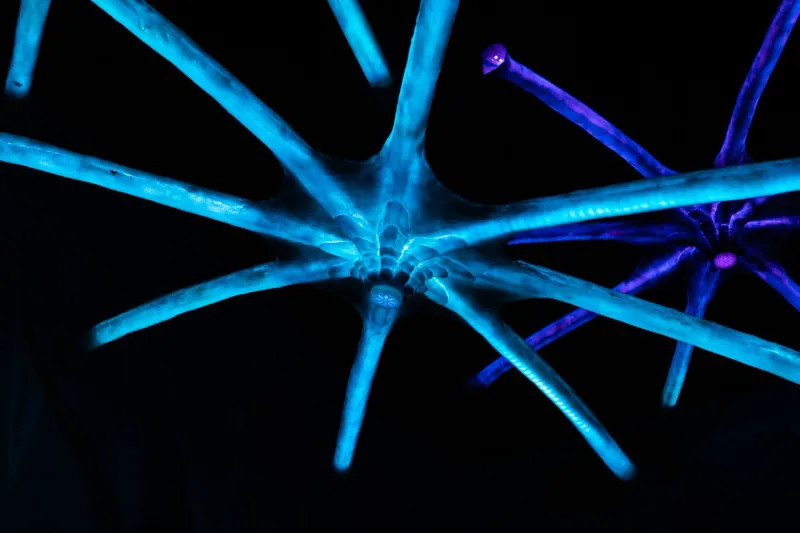
Neon has always been about energy — electricity charging gas until it radiates color. It's a beautiful, industrial process, and for nearly a century it's been the gold standard for luminous art and signage. But a small, intensely curious community of American artists and biologists is working on something that makes traditional neon look almost quaint: light that's generated by living organisms, engineered at the genetic level, and capable of responding to its environment in real time.
This is bioluminescent art, and it's weirder, more beautiful, and more technically demanding than almost anything happening in contemporary visual culture right now.
When the Lab Becomes the Studio
The collaboration between art and biology isn't new — bioart has been a recognized practice since the 1990s. But the specific intersection of bioluminescence and neon aesthetics is something that's accelerated dramatically in the past five years, driven by falling costs in genetic engineering tools, growing interest in sustainable design, and a cultural moment that's increasingly obsessed with glowing, electric visuals.
At the University of California San Diego, biophysicist Dr. Tomás Alvarado has been working with a rotating group of MFA students and independent artists through an informal residency program he runs out of his lab. The arrangement is simple: artists get access to equipment and expertise; researchers get creative problems that push their work in unexpected directions.
"Artists ask different questions," Alvarado says. "A scientist might ask how we optimize the intensity of bioluminescent output. An artist asks what happens if we make it pulse in response to sound. Those aren't the same question, and answering the second one teaches you things the first one never would."
The Organisms Doing the Work
Bioluminescence occurs naturally in a staggering range of organisms — fireflies, deep-sea jellyfish, certain fungi, marine bacteria, and dinoflagellates (those single-celled organisms that make ocean waves glow blue on warm nights). Artists working in this space draw on several of these sources, each with different aesthetic and practical properties.
Dinoflagellates are a favorite entry point because they're relatively easy to culture, produce a vivid blue-green light when mechanically stimulated, and have a natural rhythm that feels almost choreographic. New York-based artist Sasha Moreno has built a series of large-scale installations using dinoflagellate cultures suspended in custom-blown glass vessels — a deliberate echo of traditional neon tube forms.
"I wanted the visual language to rhyme with neon," Moreno explains. "Same silhouette, completely different biology. When you walk past one of the vessels and the light responds to your movement, there's this moment where people don't understand what they're looking at. That confusion is the piece."
More technically ambitious projects work with genetically modified organisms — typically bacteria or yeast engineered to express luciferase, the enzyme responsible for bioluminescence in fireflies. These approaches allow for much more precise control over color, intensity, and trigger conditions, but they require biosafety protocols, institutional support, and a level of molecular biology knowledge that most artists simply don't have on their own.
That's where the collaborations come in.
Building the Bridge Between Disciplines
In Boston, a nonprofit called BioArt Labs has spent the past three years building infrastructure specifically designed to support artist-scientist partnerships. The organization provides lab space, safety training, and access to researchers at nearby universities. It also runs a matching program that connects artists who have a clear creative vision with scientists who have relevant expertise.
Program director Keiko Tanaka describes the early stages of most collaborations as "productive chaos." Artists arrive with aesthetic goals that scientists find alternately fascinating and baffling. Scientists offer technical constraints that artists initially resist before finding creative ways around them.
"One artist wanted living neon that changed color based on air quality data," Tanaka recalls. "The scientist she was matched with told her that was basically impossible with current bioluminescent proteins. Three months later they had a prototype that wasn't exactly what she imagined but was honestly more interesting. That's usually how it goes."
The color limitation is a real one. Natural bioluminescence skews heavily toward blue-green wavelengths, and while genetic engineering has expanded the palette somewhat — researchers have developed proteins that emit yellow, orange, and even red light — replicating the full chromatic range of neon gas remains out of reach. For some artists, that constraint is frustrating. For others, it's defining.
"I only work in blue-green," says Portland-based artist Devon Marsh, who creates large-scale fungal installations using bioluminescent Panellus stipticus mushrooms cultivated on sculptural substrates. "That's the color of this particular kind of life. I'm not trying to fake neon. I'm trying to show people something neon can't do — something that grows."
The Sustainability Argument
One of the most compelling aspects of living light for designers and architects is its potential as a sustainable alternative to electric lighting. Traditional neon requires continuous electrical input; bioluminescent organisms generate light through chemical reactions powered by their own metabolic processes.
The practical applications are still largely theoretical — current bioluminescent output is far too dim for functional architectural lighting — but the trajectory of the research is encouraging. A 2023 study from MIT demonstrated a significant increase in sustained bioluminescent output from engineered plant cells, and several biotech startups are actively working on commercializing living light for interior design applications.
Interior designer Rafael Cortez, who runs a high-end residential practice in Miami, has been following the space closely. "My clients are already asking about it," he says. "They've seen the installations. They want something that lives in their home. The question is when the technology catches up to the desire."
What This Means for Neon Culture
For the neon community specifically, living light represents something philosophically disruptive. Neon has always been defined by its industrial character — gas, glass, electricity, human craft. Bioluminescent art shares the visual language but replaces the industrial logic with a biological one.
Some traditionalists are skeptical. Others are genuinely excited by the expansion of what glowing art can mean. Artist Marcus Webb, who works with salvaged neon, sees the two practices as complementary rather than competitive. "Dead signs, living organisms — both are about light that carries history," he says. "One carries the history of a place. The other carries the history of evolution. I think that's kind of incredible."
What's clear is that the boundary between neon aesthetics and biotechnology is getting more porous every year. The artists and scientists working at that boundary aren't just making beautiful things — they're asking genuinely new questions about what it means for something to glow.