The Last Benders: America's Vanishing Neon Craftspeople and the Race to Save What They Know

Photo: Volkswagen Bank direct, Public domain, via Wikimedia Commons
In a workshop on the outskirts of Cincinnati, a woman in her late sixties is teaching a thirty-year-old how to talk to glass. That's more or less how she describes it — not bending, not shaping, but listening to the tube as it heats, reading the way it softens, knowing by feel and sound and color when it's ready to move and when it'll crack if you push it.
She's been doing this for over forty years. She learned from a man who learned from a man who learned the craft in the 1940s. And for a long time, she wasn't sure she'd find anyone willing to learn from her.
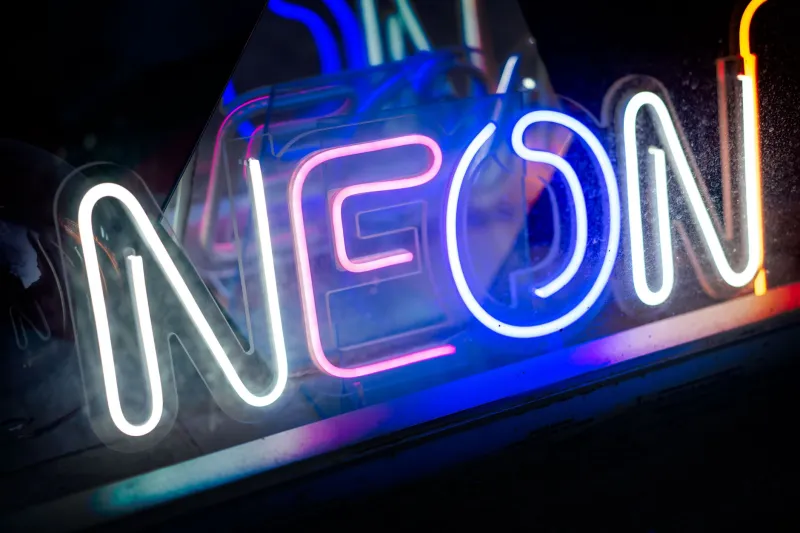
This is where American neon actually lives right now — not in the LED strips wrapping Instagram studios or the algorithmically generated neon-aesthetic graphics flooding your feed, but in a handful of workshops like this one, where the real knowledge is concentrated in aging hands and is, slowly and without much fanfare, beginning to disappear.
A Craft That Never Scaled
Traditional neon sign making is one of those trades that resisted industrialization almost entirely. You can automate a lot of manufacturing processes, but you cannot automate glass tube bending. The work requires a person to heat a length of borosilicate or lead glass over a ribbon burner, read the material's behavior in real time, and shape it into precise curves and angles using nothing but physical intuition refined over thousands of hours of practice.
The gas chemistry is equally unforgiving. Different gases produce different colors — mercury vapor for blue, neon for the orange-red that gives the medium its name, argon with phosphor coatings for a range of other hues. Getting the fill right, sealing the electrodes correctly, and testing the finished tube requires knowledge that lives in the practitioner, not in a manual.
At its peak in mid-century America, neon sign making supported thousands of specialized shops across the country. Every city had several. Small towns had at least one. The trade was unionized in many markets, and skilled benders made decent livings.
The decline was gradual and then sudden. Plastic channel letters replaced glass tubes on most commercial signage starting in the 1970s. LED technology accelerated the shift dramatically in the 2000s. Shop after shop closed. The apprenticeship pipelines dried up. The people who knew the craft aged out, and most of them didn't have anyone to pass it to.
Counting What's Left
Exact numbers are hard to come by — there's no national registry of neon craftspeople — but industry observers estimate that fewer than a thousand people in the United States currently possess genuine, full-spectrum neon fabrication skills. Of those, a significant portion are over fifty. The knowledge distribution skews heavily toward older workers in ways that make the succession problem obvious and urgent.
The shops that survive tend to fall into a few categories. Some are legacy operations that have been in families for generations and managed to hold on through sheer stubbornness and a loyal client base. Some are restoration specialists, doing the painstaking work of repairing vintage signs for museums, collectors, and preservation organizations. And a smaller number are newer operations run by people who sought the craft out deliberately, often drawn by artistic interest rather than commercial need.
That last group is arguably the most important for the craft's long-term survival. They're the ones actively recruiting apprentices, building training programs, and treating neon fabrication as an art form worth preserving on its own terms.
The Apprenticeship Problem
Traditional apprenticeship — working alongside a master for years, absorbing knowledge through proximity and repetition — is the only mechanism that has ever successfully transmitted neon skills. The problem is that it's economically brutal for both parties.
For the master craftsperson, taking on an apprentice means accepting reduced productivity during the training period, which can stretch to three or four years before a student is genuinely useful. For the apprentice, it means accepting low pay for years while developing skills that the broader job market doesn't particularly reward. The economics only work if you're genuinely passionate about the craft, and even then, they're tight.
Some shops have experimented with structured apprenticeship programs that try to compress the timeline and formalize the curriculum. A few community colleges in cities with active neon cultures — Los Angeles, New York, Chicago — have added neon bending to their continuing education offerings. The results are mixed. You can teach the basics in a semester, but the deep intuitive fluency that separates a competent bender from a truly skilled one takes years that a course simply can't provide.
What's emerging in some corners of the craft community is a hybrid model: formal instruction for foundational technique, followed by extended mentorship with working professionals for the refinement that only comes from doing the work repeatedly under real conditions. It's not a perfect solution, but it's a more realistic pipeline than either pure apprenticeship or classroom instruction alone.
The Hybrid Technique Question
There's a separate and somewhat contentious conversation happening about whether traditional neon skills need to survive in their pure form or whether hybrid approaches — combining glass tube work with LED technology, digital design tools, and new materials — might be a more viable path forward.
Some established craftspeople are skeptical, arguing that the hybrid approach risks producing practitioners who understand neither tradition fully. Others are more pragmatic. If the choice is between a craft that survives in modified form and one that disappears entirely, the modification starts to look a lot more acceptable.
A growing number of younger artists are approaching neon without strong allegiance to either camp. They're interested in what the medium can do, not in maintaining its historical purity. They'll use glass tubes when glass tubes serve the work and LED alternatives when they don't, and they're building technical vocabularies that draw on both traditions.
Whether that constitutes neon craftsmanship in the traditional sense is a debate worth having. But it's also, possibly, what keeping the glow alive actually looks like in practice.
What Gets Lost
Here's what worries the people who care most about this: it's not just a technique that disappears when the last skilled bender retires without a successor. It's an entire sensibility — an understanding of light as a physical, material phenomenon with particular qualities and behaviors that can only be known by working with it directly.
LED neon approximates the look. It can get very close. But people who've worked with both will tell you that real gas-discharge neon has a quality of light — a depth, a slight flicker, a spectral character — that the imitation doesn't fully capture. Whether most viewers can tell the difference is almost beside the point. The craftspeople can. The artists can. And once the knowledge is gone, there won't be anyone left to tell us what we're missing.
Back in that Cincinnati workshop, the lesson continues. The student is learning to read the glass, to feel the moment when it's ready. It's slow. It's frustrating. It will take years before it becomes second nature.
But she's learning. And for now, that's enough.