Your Brain on Neon: The Science Behind Why These Colors Won't Let You Look Away
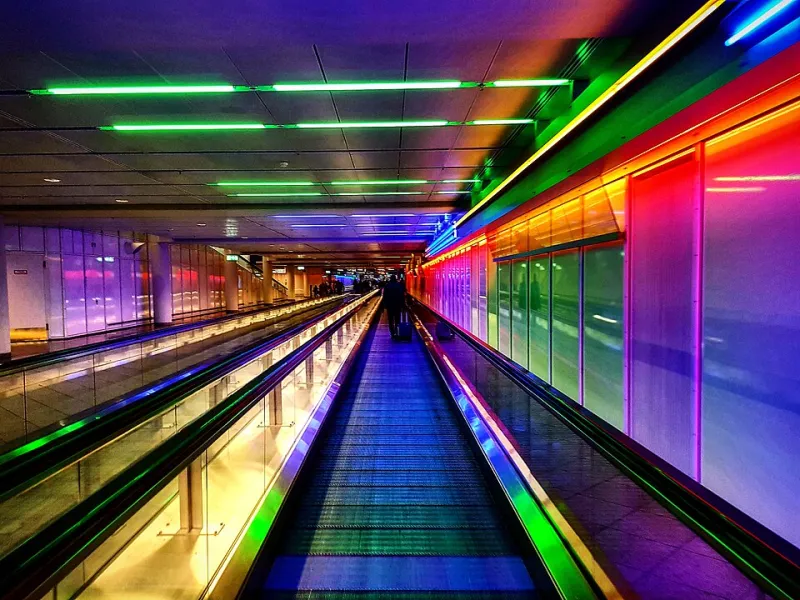
Photo: Hossam el-Hamalawy, CC BY-SA 2.0, via Wikimedia Commons
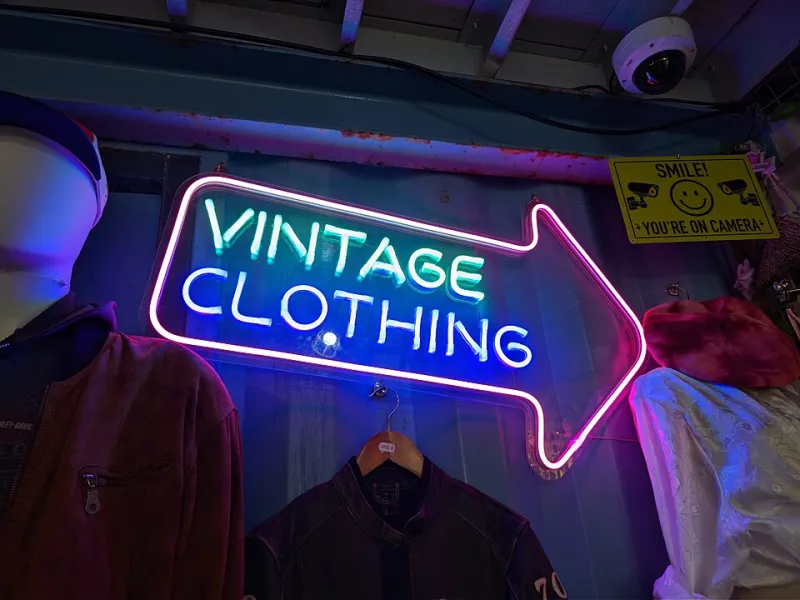
You're walking down a city block at night. Storefronts are closed, streetlights are doing their flat, utilitarian thing, and then — there it is. A neon sign, buzzing faintly, throwing magenta or electric blue across the wet pavement. You stop. You look. You might even take a photo.
You didn't decide to do any of that. Your brain did it for you.
The science of why neon commands our attention the way it does is genuinely fascinating — and it goes a lot deeper than "bright colors are eye-catching." Researchers working at the intersection of cognitive neuroscience, color psychology, and visual perception have been building a picture of what actually happens inside our heads when we encounter that distinctive glow. The answers touch on evolution, emotion, and some pretty fundamental quirks of human biology.
The Luminance Advantage
Start with the most basic level: light itself. Neon signs aren't just colored — they're self-luminous. That distinction matters enormously to your visual system.
Most objects in the world are visible because they reflect light from an external source. A red apple is red because it reflects red wavelengths from sunlight. But a neon tube generates its own photons directly. Your visual cortex processes self-luminous objects differently than reflected-light objects, treating them as higher-priority signals almost automatically.
"There's a deep evolutionary logic to this," explains the broader framework that color researchers have been developing over the past two decades. For most of human history, self-luminous objects in the environment were rare and significant — fire, bioluminescent organisms, eventually the moon and stars. Anything that produced its own light was worth paying attention to, because it was unusual and potentially important. Your brain inherited that prioritization, and it hasn't updated the firmware.
Neon exploits that ancient alert system completely by accident. The physics of gas-discharge lighting just happens to produce exactly the kind of visual signal your nervous system is predisposed to treat as meaningful.
The Wavelength Factor
Not all neon colors hit the same, and there's a neurological reason for that too.
The colors most associated with neon aesthetics — hot pink, electric blue, acid green, deep violet — cluster in wavelength ranges that correspond to particularly active responses in human color-processing cells. The eye contains three types of cone cells, each tuned to different parts of the visible spectrum, and the saturated hues that neon produces tend to stimulate multiple cone types simultaneously in ways that create a sense of visual intensity.
Cyan and blue-violet tones are especially interesting. Research in chronobiology — the study of biological time — has established that short-wavelength light (the blue end of the spectrum) has a direct pathway to the suprachiasmatic nucleus, the brain's master clock. Blue light suppresses melatonin production and increases alertness. When you see that electric blue neon sign at night, your brain isn't just processing an image. It's getting a mild neurological nudge toward wakefulness and attention.
This helps explain why neon-lit environments feel so alive after dark. It's not just aesthetic. The light is literally affecting your arousal state.
Emotion in the Frequency
Beyond attention and alertness, neon triggers something more specifically emotional — and this is where color psychology gets particularly interesting.
Studies on color-emotion associations consistently find that highly saturated, luminous colors produce stronger and faster emotional responses than desaturated or muted versions of the same hues. The saturation level matters almost as much as the hue itself. Neon colors are, almost by definition, maximally saturated — they're produced by excited gas atoms emitting very specific, narrow wavelengths rather than the broad, mixed-wavelength reflections of everyday surfaces.
That spectral purity registers as intensity. Your emotional processing centers — particularly the amygdala — respond to high-contrast, high-saturation visual input with heightened engagement. It's not the same as fear or excitement specifically; it's more like a general amplification of whatever emotional context you're already in. Neon in a joyful setting feels more joyful. Neon in an eerie setting feels more eerie. The light itself functions as an emotional amplifier.
This is probably why neon has such strong associations with both celebration (Vegas, carnival rides, concert stages) and menace (cyberpunk dystopias, crime thrillers, horror films). The light doesn't carry a fixed emotional meaning — it intensifies whatever meaning is already present.
Memory, Nostalgia, and the Glow
There's another layer that researchers find particularly compelling: the relationship between neon and memory.
Episodic memories — the specific, personal memories of events we've lived through — are encoded more strongly when they're associated with high emotional arousal. Because neon environments tend to trigger that arousal response, experiences that happen in neon-lit spaces may be encoded more vividly than experiences in neutral lighting.
This creates a feedback loop with nostalgia. If your most emotionally charged memories from childhood or young adulthood happened to involve neon — the arcade, the diner, the concert venue — then neon itself becomes a retrieval cue. Seeing it now doesn't just look like the past; it feels like it, in a visceral, pre-conscious way.
That's a significant part of why neon aesthetics have such strong nostalgic pull for Americans who grew up in the 80s and 90s. It's not just cultural association. The light itself is triggering memory retrieval pathways that are tied to high-arousal experiences from formative years.
The Uncanny Edge
One more piece of the puzzle: neon's slight wrongness.
Gas-discharge light has a spectral profile that doesn't match any natural light source. Sunlight, firelight, and incandescent bulbs all produce broad-spectrum light that human vision evolved alongside. Neon's narrow-band emission is genuinely novel to our visual system — beautiful, but subtly off in a way that keeps the brain from fully habituating to it.
Habituation is the process by which repeated stimuli become less attention-grabbing over time. Neon resists it. Because the light doesn't quite match any stored template for "normal" illumination, your visual system keeps treating it as slightly new, slightly worth a second look.
That persistent low-level novelty signal is part of what makes neon so compulsively photogenic and so hard to walk past without noticing. Your brain keeps checking it, keeps finding it slightly surprising, keeps allocating attention it would deny to a regular lamp.
So the next time you stop dead on a city sidewalk because a neon sign caught your eye — know that you didn't really have a choice. A few hundred million years of visual evolution made that decision for you, and honestly, it had pretty good taste.